Loading...

newsTicker.loading • newsTicker.loading
newsTicker.loading • newsTicker.loading
Loading...
Arthur Rahman
EcoBangla Correspondent
December 20, 2025
221
0
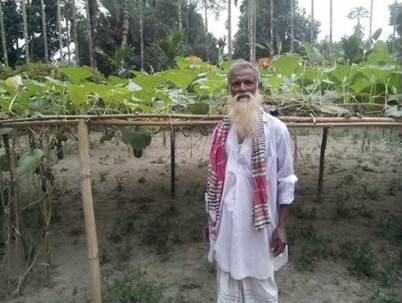
His journey spans loss and resilience: a childhood home washed away by the Dhaleshwari River, migration to Iraq and Saudi Arabia seeking better income, return to Bangladesh drawn by love of land, and transformation into an organic farming advocate. Ibrahim's story illuminates both what Bangladesh has lost in agricultural modernization and what can be reclaimed through return to sustainable practices.
The realization came through economics. Ibrahim found that nearly all money from selling crops was immediately reinvested in purchasing fertilizers, pesticides, seeds, and equipment for the next planting cycle. The treadmill of commercial agriculture kept him working without accumulating wealth or building resilience. "Before, I used to buy fertilizers for my crops. Now, I make my own organic fertilizers, which has allowed me to harvest at a very low cost," he explains. Learning organic methods provided the knowledge to break this cycle. Ibrahim learned to produce vermicompost (earthworm fertilizer) at home, building two dedicated structures for this purpose. He now uses dry leaves and jute grains as effective pesticides, eliminating chemical inputs entirely. Most significantly, he began conserving seeds rather than purchasing hybrids each season – reclaiming farmer autonomy that commercial agriculture had seized. The vegetable diversity Ibrahim cultivates demonstrates what sustainable farming can achieve: batisaka, round potatoes, eggplants, coriander, blackgram, onions, garlic, radish, sweet potatoes, beans, gourds, cowpeas, papayas, and squash. This diversity provides nutrition, spreads risk across multiple crops, and maintains soil health through varied planting patterns. It stands in stark contrast to monoculture commercial farming. Market demand validates Ibrahim's organic approach. Customers prefer purchasing from him rather than from markets because his vegetables, grown without chemical fertilizers, taste better and are healthier. His produce often sells out before reaching the market, and he receives higher prices than conventional vegetables command. The market itself recognizes that chemical-free food has value. Economic transformation has followed. Using money earned abroad, Ibrahim purchased land that he now cultivates organically. Combined with his sons' incomes (one a mechanic, one in the Army), the family faces no scarcity. But more important than wealth is the sustainable model Ibrahim has created – farming that builds rather than depletes soil, that strengthens rather than compromises health, that preserves rather than destroys diversity. The contrast with past abundance is stark in Ibrahim's memory. He recalls when every household owned cattle producing manure, hay was abundant, monsoon floods left behind fertile sediments, the Dhaleshwari River was "a mile wide and filled with hilsa," and fields grew dozens of traditional rice varieties with names like harahara, samubhanga, nejabarana, digha, and baran. This agricultural ecosystem was self-sustaining, requiring minimal external inputs yet producing abundant, diverse food. What destroyed this system? Ibrahim identifies multiple factors: devaluation of farming as a profession, with youth pursuing commercial jobs instead; environmental degradation including dried rivers, lakes, and ponds; loss of cattle and natural fertilizer sources; commercialization requiring purchased inputs for everything; and disappearance of traditional crop varieties replaced by hybrids requiring chemicals.

Herbal medicine practice extends Ibrahim's self-sufficiency model beyond food. His home garden contains extensive medicinal plant collection including ulatakamala, ghrtakamala, muramure, white lajajapati, maniraja, satamula, ramatulasi, tulasi, and bisajarula. He uses these herbs to treat dysentery, livestock diseases, stomachaches, headaches, night blindness, asthma, boils, snake poison, and rabies in his community. Ibrahim learned traditional medicine from his elder brother and father, carrying forward ancestral knowledge. He treats patients without charging money, instead receiving contributions of rice and lentils during his annual auspicious ceremony. This traditional healer role addresses health problems often caused by chemical-laden food, offering natural alternatives rooted in indigenous knowledge. Tree diversity surrounds Ibrahim's home as extension of his agricultural philosophy. His fruit trees include mango, jackfruit, areca, coconut, lemons, amalaki, grapefruit, hog palm, oranges, guava, pomegranate, and olives. "For me, tree planting is a hobby," he explains, collecting plants during his travels and establishing them at home. He prioritizes fruit and herbal trees over timber, gaining both food and medicinal resources. This diversity contrasts with declining tree cover Ibrahim has witnessed. "People once had gardens to plant lots of trees. Nowadays, people only plant trees on their rooftops and that is not really a lot of space." His personal forest represents resistance to this trend, demonstrating that even individual households can maintain remarkable biodiversity. Freedom fighter status adds poignant dimension to Ibrahim's story. At 26, working in a Jessore brick factory when the 1971 liberation war began, he received three days of training at Jhikorgacha before joining operations to free prisoners and engage Bihari forces. After independence, lacking money for bribes, he couldn't get his name officially registered as a freedom fighter. When his certificate was destroyed in a dormitory fire while working in Iraq, his last proof vanished. "Till now, my only regret is that being a freedom fighter, my own country does not recognize me as one," Ibrahim shares. The irony is profound – a man who fought for Bangladesh's independence, who now works to preserve the country's agricultural heritage and heal its people, remains officially unrecognized. Yet he continues his work without bitterness, focused on "providing people with safe food." Community influence provides some recognition that official channels deny. People visit Ibrahim to learn his organic methods and traditional knowledge. "These people have taken my example and started their own farming methods," he notes with satisfaction. His impact spreads through demonstration rather than policy, through practice rather than programs. Future vision remains simple and clear: "My only plan is to provide people with safe food." No ambitions for expansion or profit maximization, no dreams of commercial success – just commitment to growing food without chemicals that harm consumers and environment. In an age of complexity, Ibrahim's clarity is refreshing and instructive.
Ibrahim's life illuminates critical truths about Bangladeshi agriculture. The shift from traditional to commercial farming created dependencies that benefit input companies while impoverishing farmers. Organic methods prove both economically viable and environmentally sustainable when farmers receive knowledge and support. Agricultural biodiversity provides resilience that monocultures cannot match. Traditional knowledge – whether about farming, medicine, or ecology – remains relevant and valuable. His story also reveals what's been lost: environmental abundance, community self-sufficiency, respect for farming as honorable profession, and recognition for those who serve the nation whether in war or in feeding people. Yet Ibrahim's example shows these losses aren't permanent. Through conscious choice and sustained effort, farmers can reclaim sustainable practices, rebuild biodiversity, and restore value to agriculture. Every organic farmer like Ibrahim Mian is an act of resistance against agricultural systems that prioritize corporate profit over farmer wellbeing, chemical inputs over ecological health, and short-term yields over long-term sustainability.
Join the conversation and share your thoughts!
Be the first to share your thoughts!